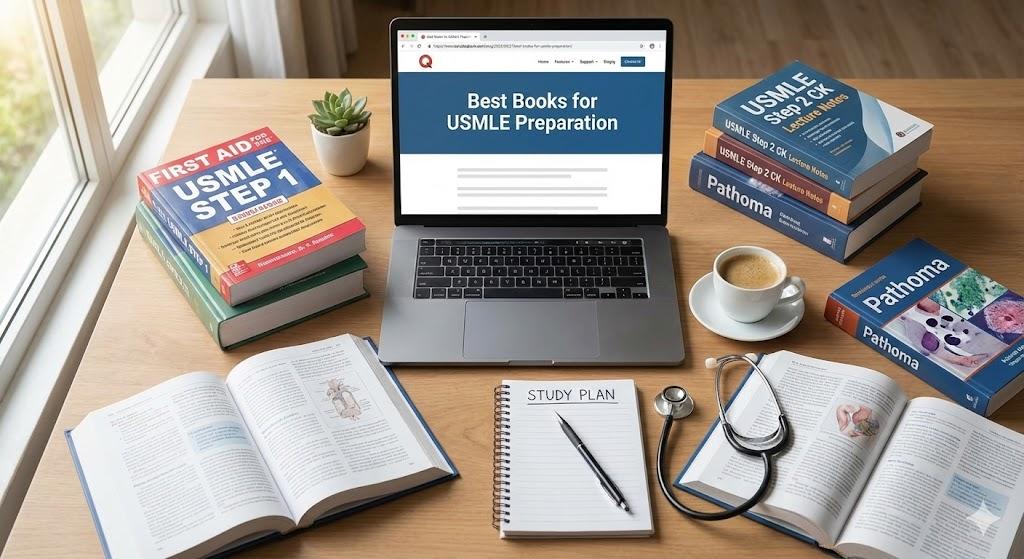
Preparing for the USMLE Step 1 requires a structured USMLE Step 1 study plan, consistent practice, conceptual understanding, and regular self-assessment.
How to Prepare for USMLE Step 1: A Complete Study Plan for Medical Students
Preparing for the United States Medical Licensing Examination (USMLE) Step 1 is an important milestone for medical students and international medical graduates (IMGs) planning to pursue medical residency in the United States.
Step 1 assesses your understanding of basic medical sciences and your ability to apply scientific concepts to clinical scenarios. Since the examination is pass/fail, your goal should be to develop a strong understanding of medical concepts, improve clinical reasoning, and achieve consistent performance on practice assessments.
However, many students struggle with one important question: How should I prepare for USMLE Step 1, and which resources should I use?
In this guide, we will discuss a practical study plan, high-yield resources, question-bank strategies, practice examinations, and common mistakes to avoid.
1. Understand the USMLE Step 1 Examination
Before starting your preparation, understand the structure and purpose of the examination.
USMLE Step 1 evaluates your knowledge of basic sciences and their application to clinical medicine. Questions are generally presented as clinical scenarios that require you to identify underlying mechanisms, interpret findings, and apply scientific principles.
Important subjects include:
- Anatomy
- Physiology
- Biochemistry
- Pathology
- Pharmacology
- Microbiology
- Immunology
- Behavioral sciences
- Biostatistics and epidemiology
Rather than memorizing isolated facts, focus on understanding how different medical concepts are connected. A well-organized USMLE Step 1 study plan helps students manage their preparation, prioritize important subjects, and track their progress.
2. Choose the Right USMLE Step 1 Study Resources
One of the biggest mistakes students make is using too many resources simultaneously. A focused approach is usually more effective.
Here are some commonly used resources.
First Aid for the USMLE Step 1
First Aid is one of the most widely used reference books for Step 1 preparation.
It provides a structured review of important basic science concepts, high-yield facts, clinical associations, and tables.
How to use First Aid effectively:
- Study one subject or system at a time.
- Understand the concepts instead of simply memorizing paragraphs.
- Annotate important explanations from your question bank.
- Review difficult topics repeatedly.
- Use diagrams and tables to strengthen retention.
Avoid trying to memorize the entire book without understanding the underlying concepts.
UWorld Question Bank
UWorld is a major question-bank resource used by many students preparing for USMLE Step 1.
It helps students develop clinical reasoning and become familiar with USMLE-style questions.
Recommended approach:
- Start with manageable question blocks.
- Read explanations carefully, including explanations for incorrect options.
- Identify why you selected an incorrect answer.
- Maintain a notebook or digital document for difficult concepts.
- Revisit challenging questions and concepts during revision.
Remember that the educational value of a question bank comes from understanding the explanations, not simply completing a large number of questions.
Pathoma
Pathoma is a popular pathology resource that helps students understand disease mechanisms, pathological changes, and clinical correlations.
It can be particularly useful when studying general pathology and systemic pathology.
Sketchy
Sketchy offers visual learning resources for subjects such as microbiology and pharmacology.
Students who benefit from visual associations may find these resources helpful for remembering organisms, medications, and their important characteristics.
Additional Resources
Other useful resources may include:
- Boards and Beyond for foundational concepts.
- Anki for spaced repetition.
- NBME self-assessments for evaluating readiness.
- USMLE official sample questions for understanding examination style.
You do not need to use every available resource. Choose a manageable combination that suits your learning needs.
3. Follow a Structured Six-Month USMLE Step 1 Study Plan
A structured schedule can help you remain consistent and avoid unnecessary delays. A successful USMLE Step 1 study plan should balance foundational learning, question-bank practice, and regular revision.
The following is an example of a six-month preparation plan. Your actual timeline should depend on your baseline knowledge, available study hours, and practice assessment performance.
Month 1: Build Your Foundation
Focus on strengthening basic science concepts.
Recommended subjects:
- Biochemistry
- Genetics
- Immunology
- General pathology
- General pharmacology
- Basic physiology
Start reviewing First Aid and use a foundational resource when you encounter difficult concepts. Following a realistic USMLE Step 1 study plan can help you maintain consistency and allocate sufficient time for revision.
Month 2: Study Organ Systems
Begin integrating basic science knowledge with clinical medicine.
Suggested systems:
- Cardiovascular
- Respiratory
- Renal
- Gastrointestinal
- Endocrine
- Reproductive
Use question-bank practice to reinforce each system.
Month 3: Complete Remaining Organ Systems
Focus on:
- Neurology
- Musculoskeletal
- Dermatology
- Hematology and oncology
- Psychiatry
- Behavioral sciences
Continue practicing questions and reviewing incorrect answers.
Month 4: Intensive Question Bank Practice
Your primary objective should now be to improve clinical reasoning and identify knowledge gaps.
- Increase your question-bank workload gradually.
- Review incorrect and uncertain questions.
- Revisit weak subjects.
- Revise important First Aid topics.
- Practice timed question blocks.
Do not focus exclusively on your question-bank percentage. Understanding your mistakes is more important.
Month 5: Assessment and Revision
Start incorporating regular practice assessments.
- Take an appropriate NBME self-assessment.
- Analyze your weak areas.
- Review high-yield subjects.
- Continue question-bank practice.
- Revisit difficult concepts.
Use your assessment results to adjust your study schedule.
Month 6: Final Preparation
The final month should focus on consolidating knowledge and assessing readiness.
- Complete remaining high-priority revision.
- Review incorrect questions.
- Take additional practice assessments when appropriate.
- Practice official USMLE sample questions.
- Maintain a consistent sleep schedule.
- Avoid starting multiple new resources at the last minute.
Only schedule your examination when your preparation and practice assessment performance indicate that you are ready. Remember that an effective USMLE Step 1 study plan should match your individual learning needs and preparation timeline.
4. How to Use UWorld Effectively
Many students complete hundreds or thousands of questions but do not improve as expected.
The problem is often their approach to reviewing questions.
For every question, ask yourself:
- What is the central clinical concept?
- What findings in the vignette are important?
- Why is the correct answer correct?
- Why are the other options incorrect?
- Which underlying basic science concept should I revise?
For example, if you encounter a question about a patient with hemolytic anemia following exposure to an oxidizing medication, review the underlying mechanism of G6PD deficiency, oxidative stress, and the role of NADPH.
This approach helps connect clinical scenarios with basic science knowledge.
5. Practice NBME Self-Assessments
NBME self-assessments are important tools for evaluating your progress and identifying knowledge gaps.
They can help you:
- Assess your current preparation.
- Identify weak subjects.
- Become familiar with examination-style questions.
- Evaluate whether your performance is improving.
- Make a more informed decision about examination readiness.
Do not interpret one practice assessment as a guarantee of passing or failing. Consider your overall performance, consistency, and understanding of the material.
Always consult the latest official USMLE and NBME resources for current examination information.
6. Common Mistakes to Avoid During USMLE Step 1 Preparation
Using Too Many Resources
Constantly switching between textbooks, videos, and question banks can make preparation inefficient.
Choose a core set of resources and use them consistently.
Memorizing Without Understanding
USMLE questions frequently require application of knowledge to unfamiliar clinical scenarios.
Understanding mechanisms is more useful than memorizing isolated facts.
Ignoring Weak Subjects
Students sometimes avoid subjects they find difficult.
Identify weak areas early and allocate additional study time to them.
Delaying Question Bank Practice
Do not wait until you have completed every subject before beginning questions.
Question-based learning can help identify gaps in understanding throughout preparation.
Ignoring Practice Assessments
Practice assessments provide valuable information about your progress.
Use them to guide your preparation rather than relying solely on how confident you feel.
7. How Many Hours Should You Study Every Day?
There is no single study schedule that works for everyone.
A dedicated full-time student may spend approximately 6–9 productive hours studying each day, while students balancing clinical work or other responsibilities may need a longer overall preparation period.
A sample daily schedule could look like this:
| Activity | Suggested time |
|---|---|
| First Aid review | 2 hours |
| Video or concept review | 1.5 hours |
| UWorld questions | 2 hours |
| Question explanations | 2 hours |
| Revision and Anki | 1 hour |
These are illustrative allocations, not mandatory targets. Adjust them according to your learning needs and available time.
Consistency and effective review matter more than simply counting study hours.
8. Tips for International Medical Graduates Preparing for USMLE Step 1
International medical graduates may have different educational backgrounds, clinical responsibilities, and preparation challenges.
Here are some practical recommendations:
- Build a realistic study schedule around your clinical or professional responsibilities.
- Strengthen foundational concepts if you have been away from basic sciences.
- Become comfortable with clinical vignette-based questions.
- Practice medical terminology and clinical reasoning in English.
- Use question-bank explanations to identify gaps in your knowledge.
- Track your progress through practice assessments.
If you are balancing work and preparation, consider a personalized timetable rather than following someone else’s schedule exactly.
9. Frequently Asked Questions About USMLE Step 1
Is USMLE Step 1 difficult?
Step 1 requires a strong understanding of basic medical sciences and their clinical applications. Its difficulty depends on your foundational knowledge, preparation strategy, and consistency.
Is First Aid enough for USMLE Step 1?
First Aid is an important review resource, but most students benefit from combining it with question-bank practice, conceptual learning resources, and practice assessments.
How long does it take to prepare for USMLE Step 1?
Preparation time varies. Some students may need approximately six months, while others may require more or less time depending on their background and daily availability.
Is UWorld necessary for Step 1?
UWorld is a widely used question bank that provides extensive practice and explanations. Students should select appropriate learning resources and use question-based practice to strengthen clinical reasoning.
Can international medical graduates prepare for Step 1 while working?
Yes. However, they should develop a realistic study schedule that accommodates professional responsibilities and provides sufficient time for revision and assessment.
What is the passing score for USMLE Step 1?
USMLE Step 1 is reported as pass/fail. Always check the official USMLE website for current examination policies and eligibility information.
10. Start Your USMLE Step 1 Journey with a Clear Plan
Preparing for USMLE Step 1 requires consistency, conceptual understanding, effective question-bank practice, and regular self-assessment. Following your USMLE Step 1 study plan consistently can help you identify weak areas and improve your examination readiness.
Instead of constantly searching for new resources, develop a structured plan and focus on identifying and correcting your weaknesses.
Remember that every student’s preparation journey is different. A study plan that works for one student may not be suitable for another.
At USMLE Pathways, we aim to help medical students and international medical graduates navigate their USMLE preparation through structured guidance, personalized study strategies, and educational support.
If you need help creating a realistic preparation schedule or improving your question-bank strategy, you can explore our USMLE tutoring services and book a consultation.
Your USMLE journey starts with the right strategy, consistent effort, and a clear roadmap.
Educational disclaimer: This article is intended for educational purposes. Examination policies, eligibility requirements, and testing procedures may change. Refer to official USMLE resources for the latest information.
email us at info@usmlepathways.com